
Energy means the ability to do work.
Whenever we do work — like moving, lifting, pushing, or pulling something — we use energy.
Types of Energy:
- Heat Energy– e.g., boiling water on a stove.
- Light Energy – e.g., sunlight helps plants grow.
- Electrical Energy – e.g., fans, lights, TV.
- Sound Energy – e.g., radio or speaker.
- Mechanical Energy – e.g., moving parts in a car or bicycle.
What are Machines?
A machine is a device that makes our work easier and faster.
Examples:
- A bicycle helps us move faster.
- A washing machine washes clothes faster.
Machines save time and effort.
Simple Machines:
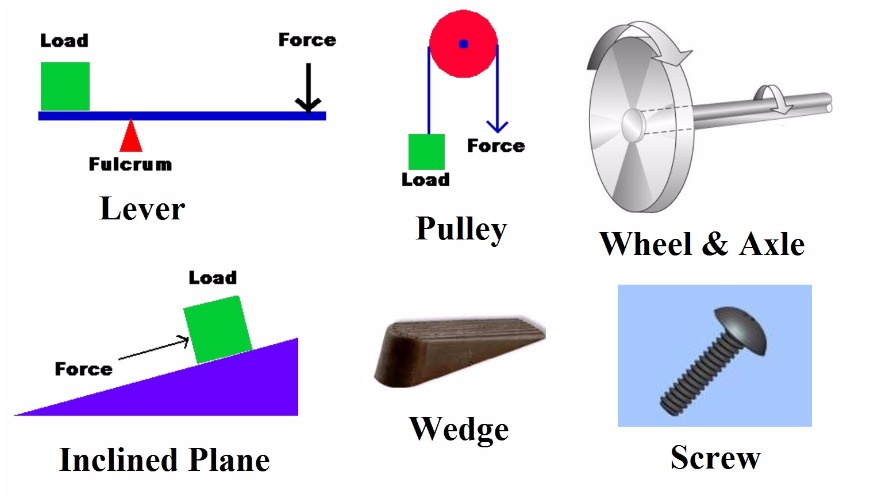
Simple machines are basic tools that help us do work easily by either changing the direction or increasing the force we apply.
Examples:
- Scissors (lever + wedge)
- Screwdriver (wheel and axle)
- Pulley (to lift a bucket from a well)
Functions of a Simple Machine
- To make work easier – e.g., using a crowbar to lift heavy stones.
- To change the direction of force – e.g., pulling water up using a pulley.
- To multiply force – e.g., using a jack to lift a car.
- To increase speed – e.g., using a bicycle.
Terms Related to Simple Machines
- Effort – The force we apply.
- Example: Pushing a door.
- Example: Pushing a door.
- Load – The weight or object we want to move.
- Example: The door itself.
- Example: The door itself.
- Fulcrum – The fixed point about which a lever moves.
- Example: The hinge of a door.
Types of Simple Machines
1️ Lever
A lever is a rigid bar that moves around a fixed point (fulcrum) to lift or move a load.
Examples:
- Scissors, see-saw, crowbar, spoon, tongs.
Parts of a Lever:
- Fulcrum (F) – The fixed point.
- Load (L) – The object to be moved.
- Effort (E) – The force applied.
Principle of a Lever
The lever works on this rule:
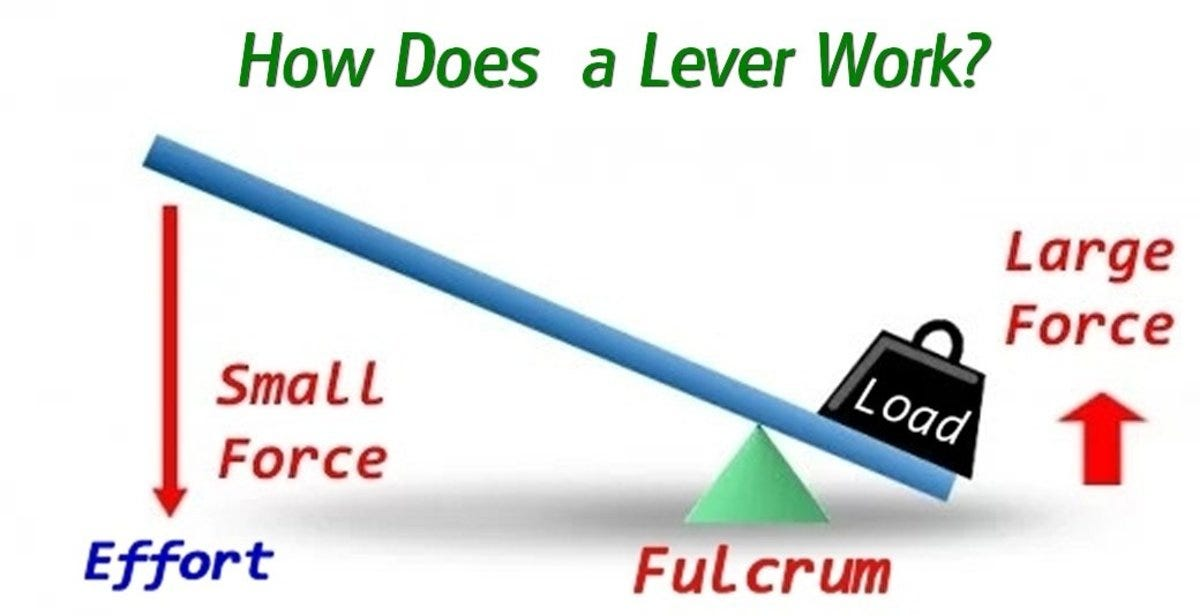
The effort × its distance from the fulcrum = Load × its distance from the fulcrum.
In short:
It balances the load with lesser effort by adjusting distances.
Mechanical Advantage
The ratio of load to effort.
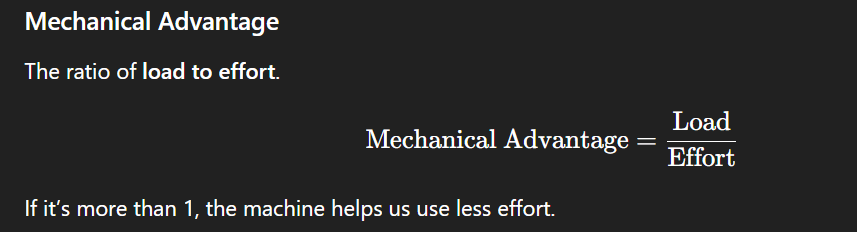
If it’s more than 1, the machine helps us use less effort.
Types of Levers
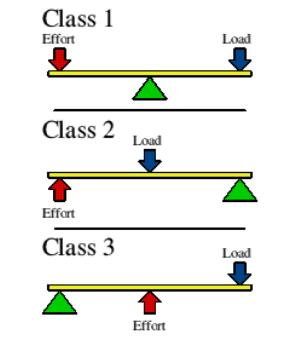
Class 1 Lever
Fulcrum in the middle (Effort–Fulcrum–Load)
- Examples: Seesaw, Scissors, Pliers.
Class 2 Lever
Load in the middle (Fulcrum–Load–Effort)
- Examples: Wheelbarrow, Nutcracker, Bottle opener.
Class 3 Lever
Effort in the middle (Fulcrum–Effort–Load)
- Examples: Tongs, Fishing rod, Human arm.
2️ Inclined Plane
A sloping surface used to move heavy objects easily.
Example: A ramp or slide.
Use: It reduces the effort needed to lift heavy objects.
3️ Wedge
Two inclined planes joined together to make a sharp edge.
Examples: Knife, Axe, Nail, Needle.
Use: Helps in cutting or splitting objects.
4 Pulley
A wheel with a rope around it used to lift loads.
Types:
- Single Fixed Pulley: Changes the direction of force. (e.g., drawing water from a well)
- Single Movable Pulley: Reduces effort. (e.g., lifting a load with cranes)
5️ Screw
A metal rod with a spiral groove used to hold things together or lift weights.
Examples: Bottle cap, Jar lid, Screw jack.
Use: Helps in fixing and lifting with less effort.
6️ Wheel and Axle
A wheel is attached to a small rod (axle). When one moves, the other moves too.
Examples: Steering wheel, Door knob, Bicycle, Grinder.
Use: Helps in moving or rotating objects easily.
Care of Machines
- Keep machines clean and dry.
- Oil and grease moving parts regularly.
- Do not overload machines.
- Store properly after use.